

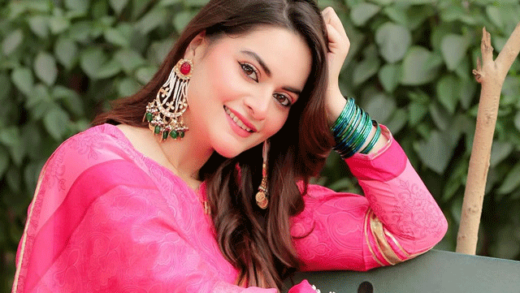

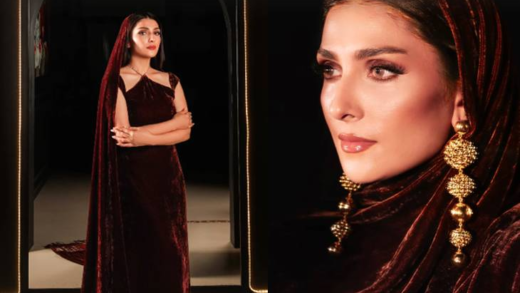
A new controversy has gripped Pakistan’s entertainment landscape after Nadia Khan publicly confronted rapper Talha Anjum for waving the Indian flag during his recent concert in Nepal. What began as a segment on her morning show quickly evolved into a heated national debate touching upon patriotism, artistic freedom and the role of public figures.
Talha Anjum, one of Pakistan’s most prominent young rappers, had already admitted the act was a mistake and issued an apology online. Yet the backlash continued, prompting Nadia Khan to host him on her show and question him directly. She argued that the gesture “hurt the sentiments of the majority of the Pakistani nation,” further linking it to the long-standing Pakistan-India conflict.
During the exchange, she also referenced his earlier online remarks, including a post made during the Pahalgam incident, and asked why he chose to wave the Indian flag despite Pakistan’s fraught history with its neighbour. Talha Anjum responded by reaffirming that he is a “proud Pakistani artist” and insisted that the incident was not intended as a political statement.

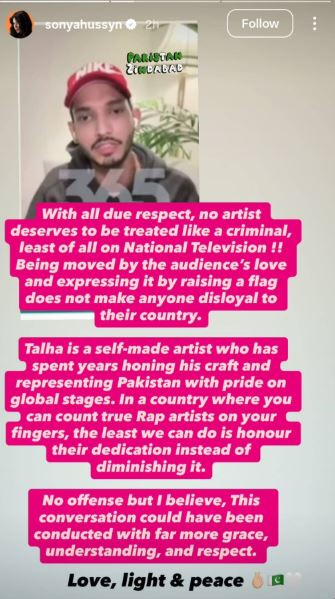
As the clip went viral, several celebrities rallied behind Talha Anjum. Yasir Hussain said the rapper had represented Pakistan internationally and deserved acknowledgment rather than hostility, urging viewers not to turn into hyper-nationalist TV hosts. Musadek Malek went even further, criticizing Nadia Khan’s tone and calling her commentary disrespectful. Sonya Hussyn also voiced her concern, stating that no artist should be spoken to in such a manner on national television. Kinza Hashmi joined the wave of support, subtly endorsing Talha without naming Nadia directly.

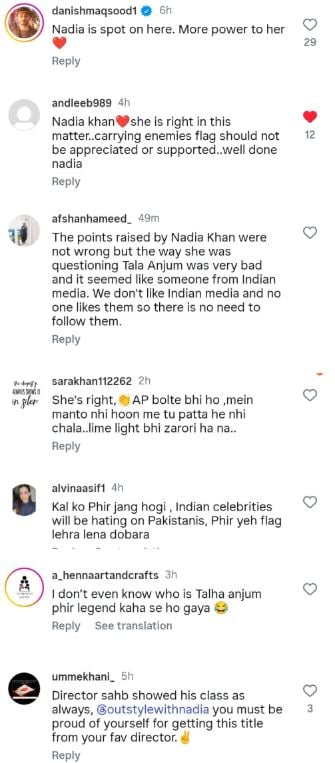
Public reaction, however, remained sharply divided. Many argued that waving an Indian flag was unwise and insensitive, especially given the tense political climate. Others countered that global performers interact with diverse audiences and that gestures at concerts often carry no political intent. Some fans pointed out that Indian celebrities regularly make strong political statements without facing the same scrutiny.
The discussion grew deeper as videos resurfaced from the Nepal performance. In those clips, Talha Anjum waved the Indian flag while Talha Younus held the Nepali flag, a gesture interpreted by many attendees as a nod to unity rather than a political stance. Audience members cheered, and several said the moment showcased the power of music to bridge distance between nations.

This broader perspective has reignited conversations about what artists owe to their audiences, whether patriotism should dictate creative expression, and how far televised accountability should go. As the debate continues across Pakistan’s digital spaces, one thing remains clear: the incident has touched a nerve at the intersection of culture, identity and artistic freedom.
Whether the conversation moves toward reconciliation or deepens the divide will depend on how both artists and audiences choose to engage in the coming days.
Comments are closed.